Casa Azzurrina
On Elba Island you can snorkel almost anywhere straight from the shore, with a mask and fins, no boat needed. The very best spots are the Elviscot wreck at Pomonte, the rocky south-west coast between Seccheto, Cavoli and Fetovaia, the Scoglietto off Portoferraio (the richest in fish) and the dark-pebble coves around Capoliveri. Below you will find each one, with how to get there, what to expect underwater and when to go.
Our home is on the south-west coast, in Seccheto, and the first spots are part of our daily life; the others are the island's most renowned places (which we still visit week by week), the ones worth knowing if you move around.
The south-west coast: the spots we know best
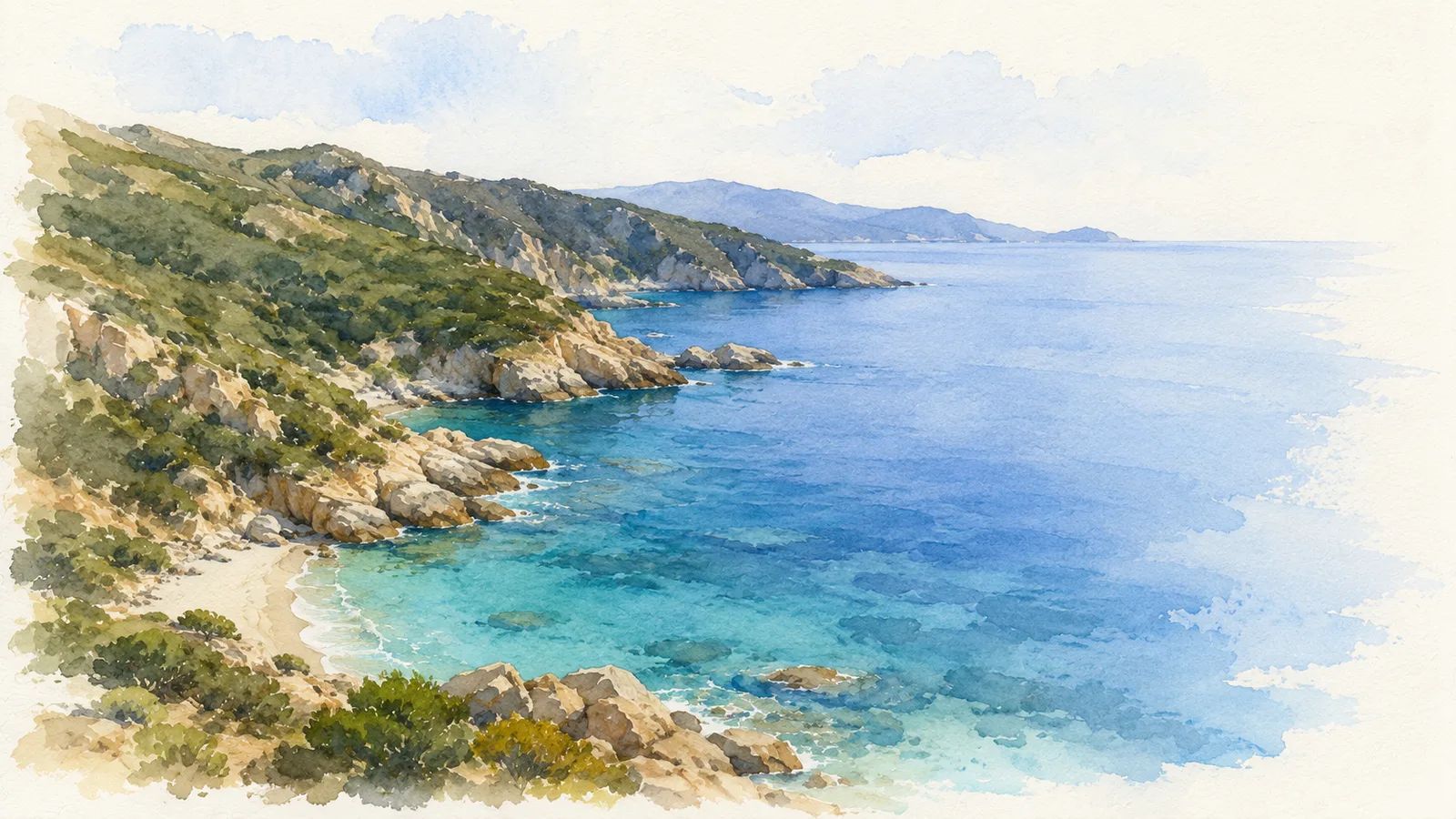
This is not the postcard Elba of beach clubs in a row. Here you find rock, Mediterranean scrub running down to the sea, water that changes colour every ten metres, and seabeds worth exploring with mask and snorkel.
The Seccheto shore
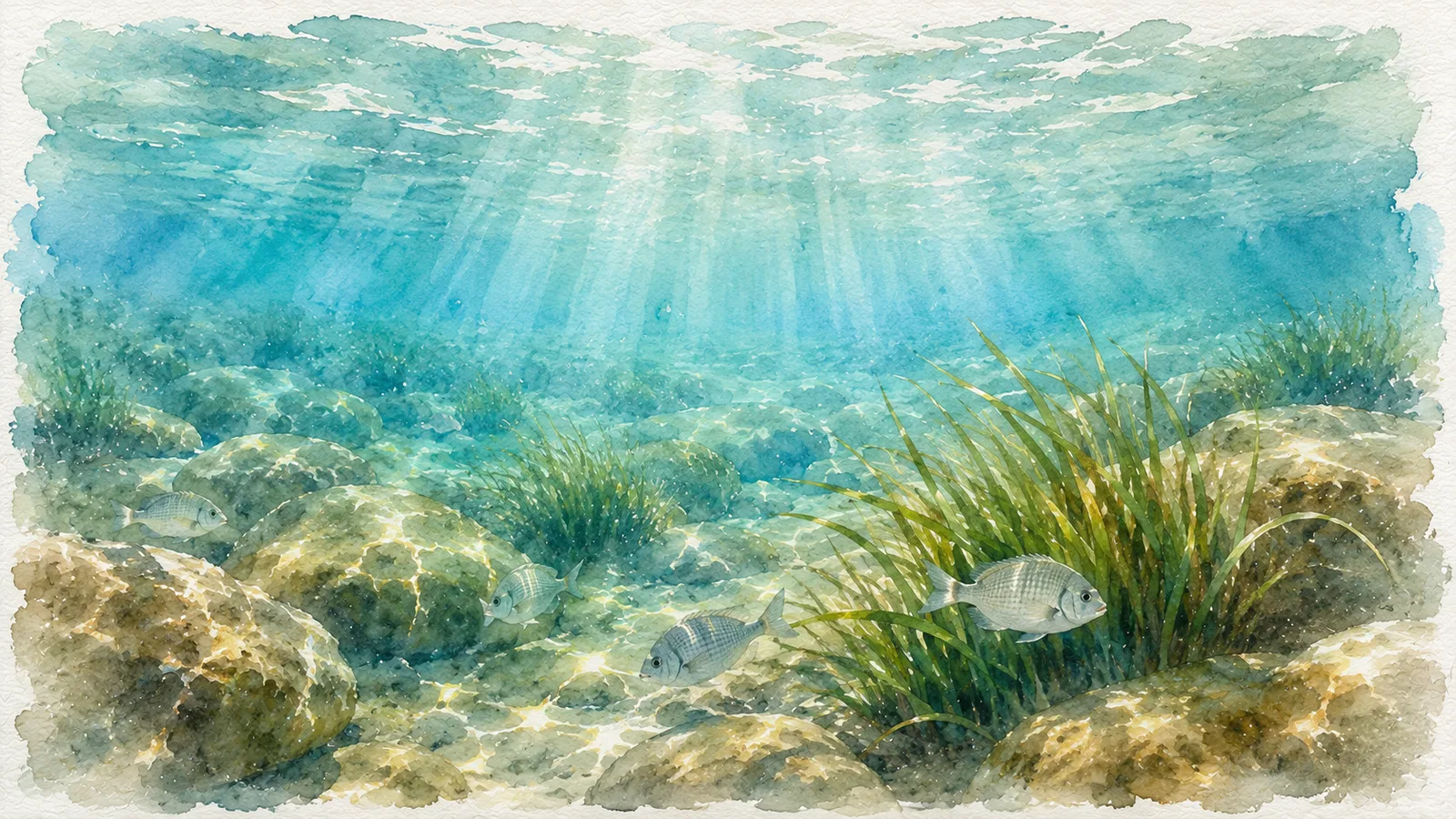
Seccheto beach has a mixed bottom: sand in the middle, rock and stones on the sides. It is exactly those rocky edges that matter for snorkeling. Move a few metres away from the swimming area and everything changes: boulders covered in algae, crevices, posidonia swaying with the current.
Seccheto is a two-minute walk from our apartment. For a swim at dawn, before the crowd arrives, or a last dip before dinner, it is ideal. The bottom suits beginners: shallow water, no significant current, good visibility on calm mornings. You will see white bream among the rocks, mullet at the surface, the odd octopus in the crevices, urchins on the boulders and small crustaceans on the bottom. Often you just slip in from the rocks on either side of the beach.
Cavoli: a few minutes east
Cavoli is the most famous beach on this coast, and rightly so. For snorkeling what counts is the rocky stretch that closes it off on both sides: a bottom similar to Seccheto, rock, sea vegetation, typical Mediterranean fish, but with a different exposure that brings some variety. Worth it if you have already explored Seccheto and want something slightly different, or a larger beach of fine sand. In high season Cavoli is crowded: come early in the morning, or off-season. Cavoli and Seccheto share the same strip of coast: the full guide is in our guide to the Seccheto coast and beaches.
Colle Palombaia: the beach of 205 steps
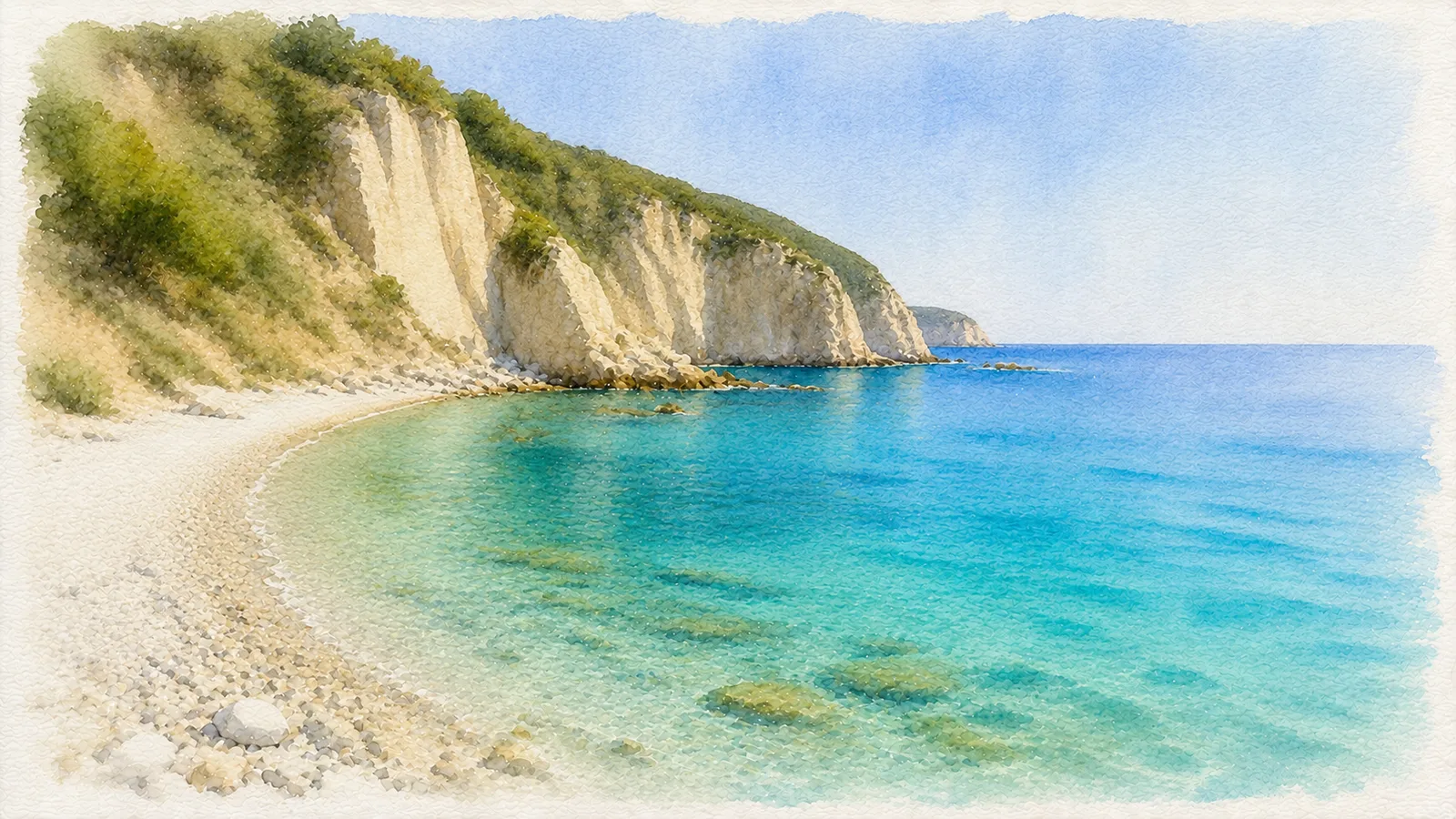
Between Cavoli and Fetovaia, Colle Palombaia (or Colombaia) is the wild beach of the Costa del Sole. People call it "the beach of a hundred steps", but the granite staircase down to the sea actually has 205: it is that descent that keeps it quiet even in August. Below you find a long stretch of dark pebbles and big boulders, framed by white cliffs, the clear water contrasting with the grey stones. For snorkeling what matters is the rocky perimeter on both sides, while from the shore your eye reaches Montecristo, Pianosa and, on clear days, Corsica. There are no services: bring water, shade and rock shoes. Leave the car in the gravel car park on the road to Cavoli, near the junction for San Piero and Sant'Ilario, and walk down.
The Blue Grotto: to be seen in the water
A little further on, between Cavoli and Colle Palombaia, the coast rises into a sheer cliff, and at its foot opens the Grotta Azzurra, which locals also call Grotta di Mare (Sea Grotto). The name says it all: when the sun enters at the right angle, the water inside lights up the bottom and the walls with blue reflections. It is large enough to enter with a small boat, and one of the most striking places to put on a mask. You cannot reach it on foot, because the coast is too steep: you come by sea, with a dinghy, a pedal boat hired at Cavoli, or the daily summer boat trips from Marina di Campo that include a swim stop right inside it.
Galenzana: the sheltered, silent bay
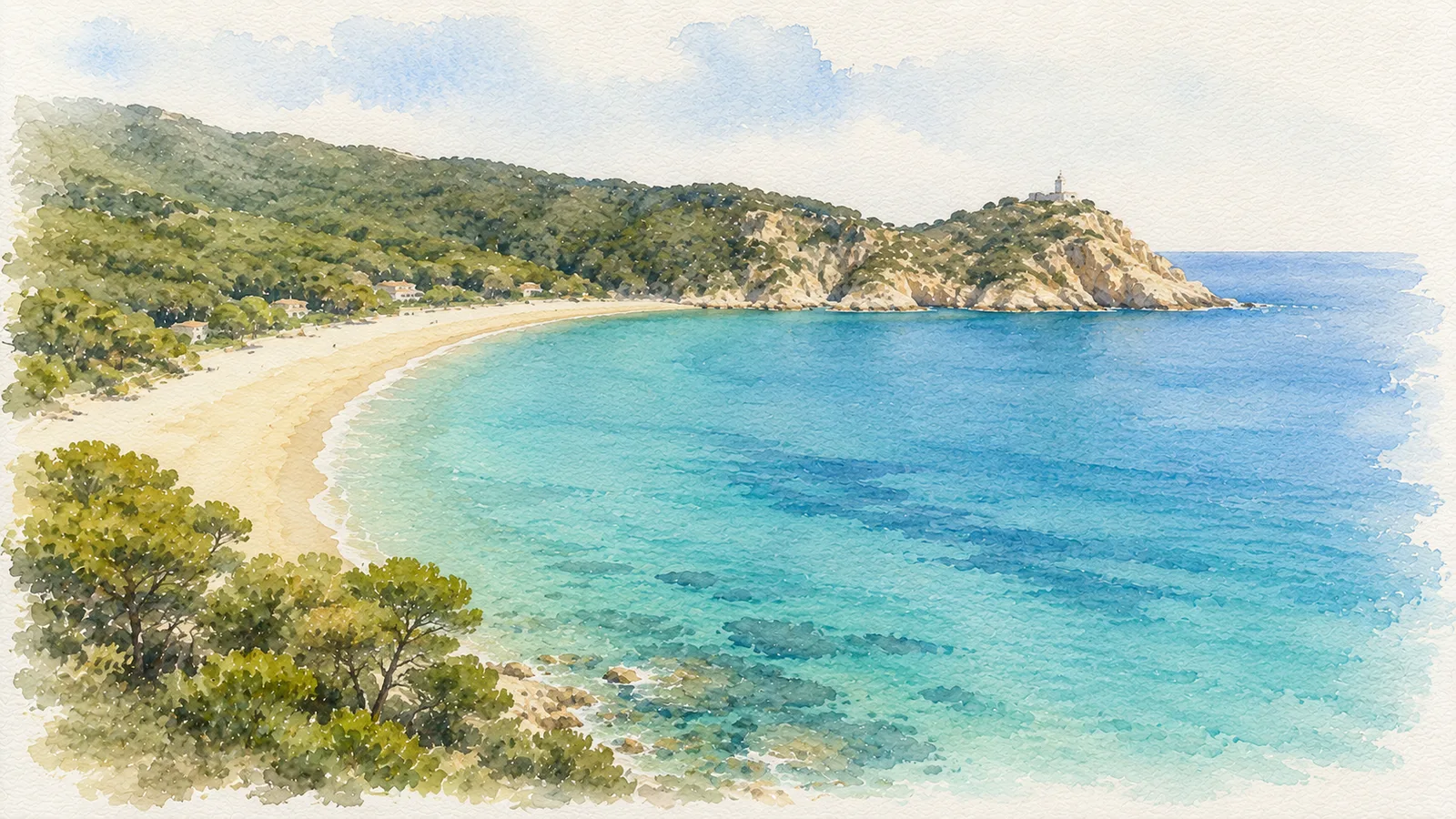
Towards Marina di Campo, hidden behind the scrub, Galenzana is the beach for those after peace and quiet: sand and fine gravel, pinewoods and tamarisks almost down to the shore, and something unique on Elba: from the beach you never see the open sea, always a strip of land, which shelters it from nearly every wind. There are no services and you reach it only on foot (an easy path of about 1.5 km, ten to fifteen minutes, starting from the steps at Piazza da Verrazzano in Marina di Campo) or by sea. The water is crystal-clear and full of posidonia, so good for snorkeling, with shallow stretches fine for children too. A curiosity for those who look down: on the sand you still find dark, smooth-stone-like fragments, the slag of the ancient furnaces that here, since the Etruscans, smelted iron using the wood of the surrounding forests.
Fetovaia: the ribbon of sand and the headland
A little further west, Fetovaia is one of Elba's signature beaches, sheltered by the headland of Punta della Madonna. That rocky headland, on the right side of the beach, is the snorkeling spot: the water stays calm when it is choppy elsewhere, the rock is jagged and full of reef fish. The soft, gently shelving sand also makes Fetovaia comfortable for going in with children.
When you come out of the water, lunch is a few steps away: the Barbatoja, a restaurant-bistrot right on Fetovaia beach, has a terrace on the waterfront and works the catch of the day; and if you would rather not leave your umbrella, it also prepares takeaway lunch boxes. At lunch we go for spaghetti alle vongole with a glass of light, well-chilled Vermentino: an Elba Vermentino DOC from Tenuta La Chiusa, straw-yellow, savoury and fresh, served at 8-10 degrees, which is just right.
The Elviscot wreck at Pomonte: the one you do not forget
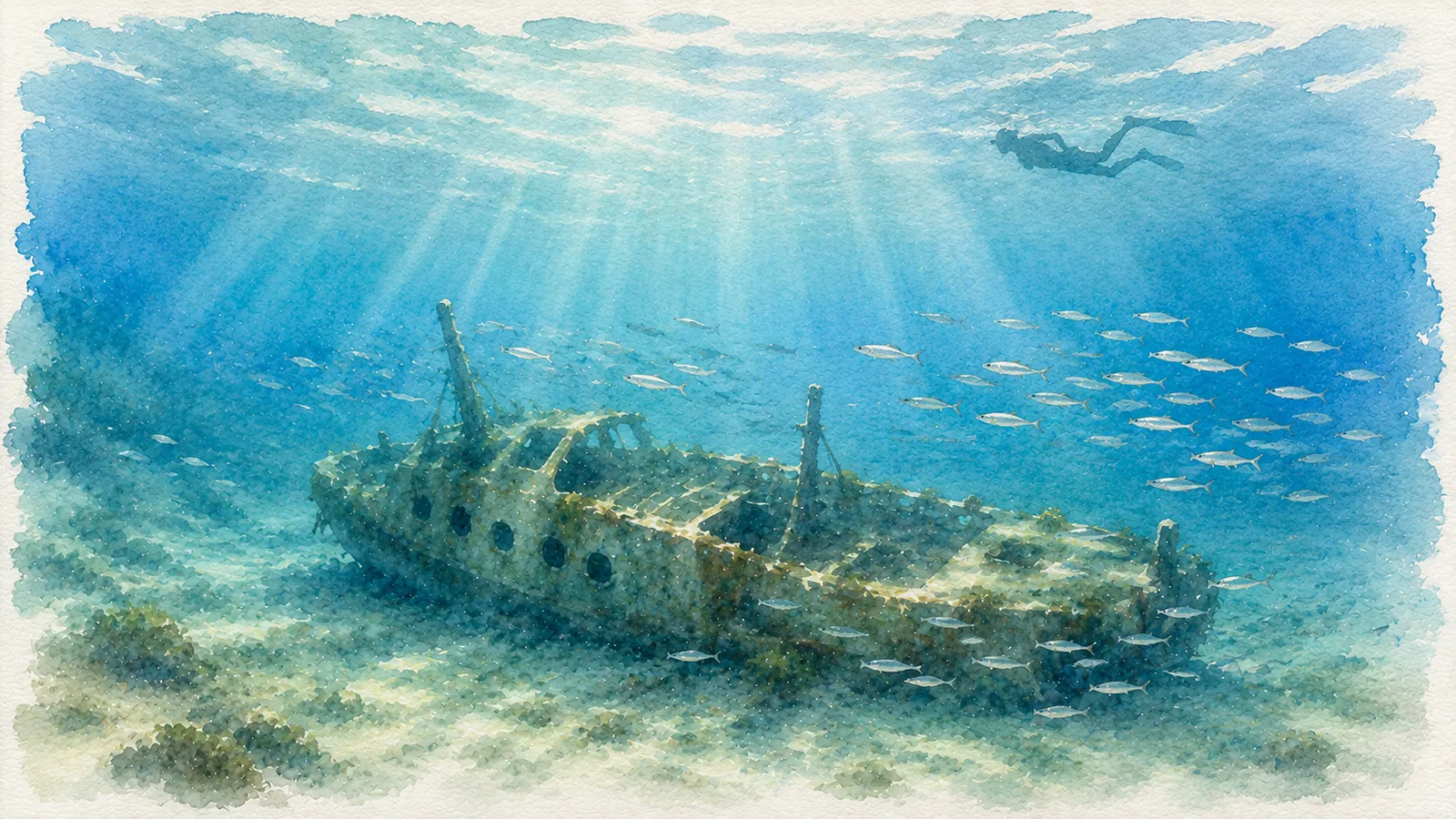
If there is one spot worth the trip on its own, this is it. Pomonte is about fifteen minutes west of Seccheto, on the same road as the restaurant L'Ogliera, which we recommend to every guest, and which takes its name from the Ogliera rock, the outcrop about 150 metres from the beach on whose eastern side, at just 12 metres deep, lies the Elviscot wreck.
The Elviscot was a small cargo ship built in the Netherlands in 1960, a little over 62 metres long. On 10 January 1972, on a stormy night with the hull taking on water, it ran aground on the Ogliera. The crew was saved; the bow, a hazard to bathers, was partly recovered, while the stern and the side were left to sink onto the sand, where they rest to this day.
It is completely submerged: nothing shows on the surface, only clear water. Then, from just below the surface, the outline of the hull emerges from the blue, with sunrays coming through the portholes and playing with the light. It is considered one of the most visited wrecks in Italy. Currents are almost always absent and the difficulty is rated as easy: suitable for snorkelers and less experienced divers too. Among the plates swim bream, conger eels and octopus, and the concentration of fish far exceeds that of ordinary beaches.
It is not a spot for small children or unsure swimmers, though: you set off from the shore but swim in deep water out to the rock. If you have one, bring a diver's buoy, as boats pass close by in summer. The best time is early, with a flat sea and high light.
Marciana Marina and the north-west: the granite of Monte Capanne
The north-west side is the wildest, most remote Elba, the one below Monte Capanne, where granite runs down to the sea, smoothed into flat slabs and natural pools. Many rank this stretch at the top for snorkeling on the island, and they have a point. The roads down to the sea are narrow and full of bends: it is worth it, but set off early, because the car parks are small.
Sant'Andrea and Cotoncello: granite and crystal-clear water
Sant'Andrea, in the municipality of Marciana, is the name you will hear most when snorkeling on Elba comes up, and it has some of the clearest water on the island. The credit goes to the "Cote Piane": huge slabs of smooth granite, speckled with white feldspar crystals, sloping into a sea that shifts from turquoise to deep blue. The bottom shelves gently for the first few metres and then drops; along the rocks the water is crystal-clear and marine life abundant. Offshore, the emerging rocks of the Formiche di Zanca hide sponges, wrasse, saddled bream and octopus: that is where the more confident swimmers push out.
On the right of the beach, a scenic path of wooden footbridges and passages carved into the rock leads to Cotoncello, a tiny cove of pale sand enclosed by white granite cliffs. In front of the shore the water stays shallow for many metres: a natural pool, perfect for children and beginners. There are no services, so bring water and shade. And if you happen by between April and May, the cliffs blaze with the fuchsia of the Hottentot fig. You get there by car from Marciana or Marina di Campo along the Monte Capanne ring road; the final descent is narrow and the car park small.
Marciana Marina: the little harbour and the tower
Marciana Marina is the north-west's seaside town: a small place gathered around its little harbour. Along the seafront is the Cotone, the old fishermen's quarter with houses right on the water, and the old round Appiani tower guarding the inlet. It is not a postcard dive spot, but along the rocky edges on either side of town the water is clear and the swimming good, and it is the gateway to the coves around: Cotoncello and Sant'Andrea to the west, the bays of the Gulf of Procchio to the east. In the evening it is a lovely place to come back to, for a stroll on the pier and dinner by the sea.
And you eat really well here. Three addresses we recommend, each different. For seafood first courses, the Rendez Vous: a historic fish restaurant, opened by chef Marcello Landi in 1970, with a terrace right on the harbour. For creative cooking, Umami by Leandro Carotenuto, in the Cotone quarter, where the fresh catch is reinterpreted with flair (it is listed in the Golosario guide too). And for straightforward Elban tradition, La Scaletta, a family trattoria-pizzeria near the square, with honest seafood cooking, generous portions and good value.
Redinoce and Spartaia: the bays of the Gulf of Procchio
Between Marciana Marina and Procchio open two inlets worth the mask. Redinoce is the more secluded: a slightly hidden cove, reached by leaving the car and walking a few minutes, with crystal-clear water and, above all, the Paolina islet right in front. Around Paolina the bottom is varied and full of fish, one of the north coast's favourite snorkeling spots. From the water you can see the Gulf of Procchio and, on the horizon, the Enfola peninsula.
Spartaia is easier and better for families: a small fine-sand beach set between two scrub-covered spurs, with water shading from turquoise to emerald and a sandy bottom that shelves gently, with even a shallow bank where children learn to swim. For snorkeling what counts is the perimeter: along the cliffs that close the bay you meet small fish, starfish and the odd octopus in the crevices. There are bars and rentals, including kayaks and SUPs, with which you reach nearby Paolina in about ten minutes. You get there from the Procchio-Marciana Marina road, down a narrow one-way lane; in summer it is crowded, so the usual rule applies: early in the morning.
Portoferraio and the north coast: clear water and the marine park
On the northern side the water is often a transparent turquoise, and here is the island's most fish-rich spot.
The Scoglietto off Portoferraio: the richest in fish
The Scoglietto is an islet with a small lighthouse off Portoferraio, and the waters around it have been a biological protection zone since 1971: the stretch of sea between Punta Falcone and Capo Bianco, in front of Le Ghiaie beach, where every form of fishing (professional, sport, recreational and spearfishing) has been banned for over fifty years. That is exactly what makes it the liveliest seabed on Elba: with no fishing pressure, groupers, dentex, corb and amberjack stay calm and let you come close. One of the most loved dive points is called precisely "la franata delle cernie" (the groupers' rockslide). The area is also recognised at European level as a Site of Community Importance and a Special Protection Area.
The Scoglietto itself is reached by boat, on an organised trip or a hired dinghy, but the same protected waters face onto Le Ghiaie beach, so you can see something from the shore too. It is the right destination if snorkeling is the reason for your trip, not just a beach pastime. And if you go, remember that respecting the bans here is not red tape: it is the reason for all those fish.
Sansone, Padulella and Capo Bianco: the white cliffs
West of Portoferraio, this row of white-pebble, pale-rock beaches offers some of the most transparent water on the island. The bottoms are bright and, along the rocky edges, full of life. Sansone and Capo Bianco in particular are beaches with no services, a little wild: quiet mornings guaranteed if you arrive early.
Capoliveri and the south-east: coves and dark pebbles
On the Capoliveri side the beaches become small coves of dark pebbles, with surprising seabeds.
Innamorata, Barabarca, Zuccale and Norsi
The Innamorata bay looks out on the Gemini rocks offshore and is loved for its clear water and varied marine life. Nearby, Barabarca, Zuccale and Norsi are tucked-away coves, often of dark pebbles, where the rocky sides offer good seabeds: at Norsi you meet octopus and, with a little luck, lobster hidden among the rocks. These are morning spots, before they fill up.
By boat: Pianosa, the offshore rocks and the cetaceans
About thirteen kilometres south-west of Elba lies Pianosa: flat, as its name says, just 29 metres at its highest point, and one of the clearest seas in the archipelago. It belongs to the municipality of Campo nell'Elba, like Seccheto, but it is another world. They call it "the island of silence", and the reason lies in its layered history: frequented since prehistory, a place of exile in Roman times (Agrippa Postumus, grandson of Augustus, was confined here), then an agricultural penal colony from 1858 and a prison until 1998. Today the whole island is under archaeological protection and its waters are protected by the Tuscan Archipelago National Park.
Precisely because it is protected, Pianosa cannot be visited freely. You arrive by sea: the Aquavision motor boat leaves Marina di Campo every day and reaches Pianosa in about 45 minutes (in high season it also sails from Piombino), and one day a week there is the Toremar ferry. On land you can move about on your own only in the village and at Cala Giovanna, the only beach where swimming is allowed; for the rest of the island you need a Park guide.
For snorkeling this means two things. If you go for the day, the water at Cala Giovanna is already a show: shallow, transparent, with pale sand that makes the sea look like a natural pool. To go further, into the protected belt of sea, the Park has laid mooring buoys and diving is done only with authorised dive centres; there is also a guided snorkeling excursion, bookable through the Info Park. Everywhere one simple rule applies: take nothing and leave nothing, not even a cigarette butt. You carry everything out, because on Pianosa there are no bins, and that is fine: it is the fair price for a sea that has stayed as it was.
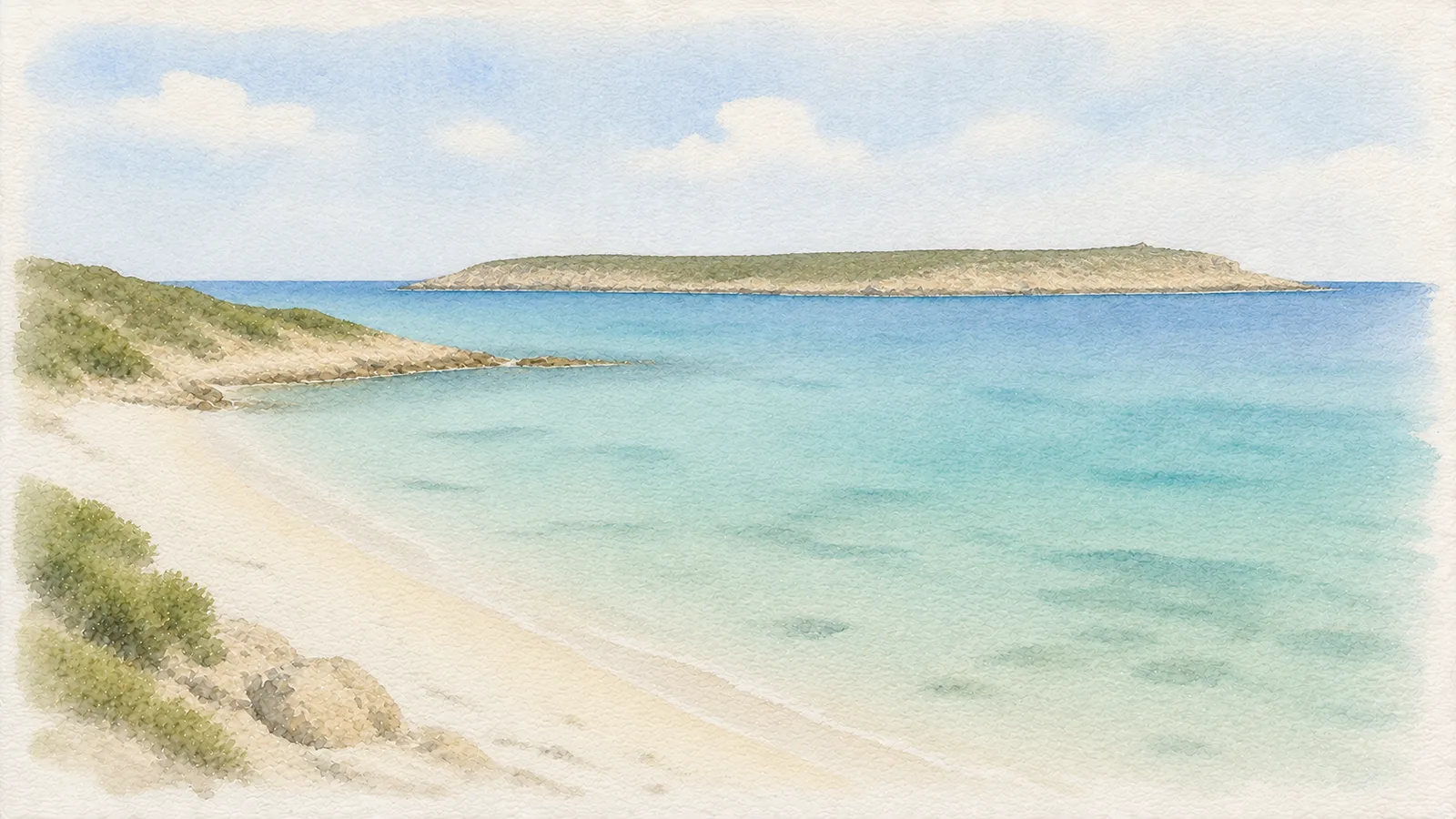
On Elba's eastern side, instead, the offshore rocks such as Palmaiola, Isola dei Topi and the Ortano rock are classic dive sites of the Cavo area. And the whole area falls within the Pelagos Sanctuary for cetaceans: on some boat trips you happen to cross paths with dolphins.
Dolphins on Elba: how and where to really spot them
First, an honest note: there is no "swimming with dolphins" on Elba. The dolphins in this sea are wild animals, not the guests of a dolphinarium, and you watch them from a boat, offshore. Chasing them or jumping in to swim after them disturbs them and must be avoided: Elba's waters are part of the Pelagos Sanctuary, the marine protected area for cetaceans (about 87,500 km² across Italy, France and the Principality of Monaco), and here the animals are respected. That said, spotting them is a real thrill, and the odds are higher than you might think.
Who lives in this sea
The Pelagos Sanctuary is one of the richest stretches of the Mediterranean: besides striped dolphins and bottlenose dolphins, the ones most often seen, fin whales, sperm whales, Risso's dolphins and pilot whales also pass through. Around Elba in particular, research by those studying the archipelago's cetaceans points to a fairly resident group of bottlenose dolphins on the north-west side, in the triangle of sea between Punta Polveraia, Capo d'Enfola and the island of Capraia. It is the same corner as Sant'Andrea and Marciana Marina: the very coast we described for snorkeling is also the best for dolphins.
When and how
They can be seen all year, but the best chances come with a calm sea and often outside the peak months, when the water is quieter and there is less traffic. A sailing boat is the most suitable because it is silent; dinghies and motor boats are fine too, as long as you go slowly. If you are lucky enough to meet them, a few common-sense rules apply: keep your distance, do not head straight at them but move in parallel, hold a steady, slow speed, and do not chase them. If anything, they are the ones who come closer, to play in the bow wave.
The boat trip
The simplest and most respectful way to try is a trip with a guide, who knows where to look and how to behave. Trips usually leave from Portoferraio, Marciana Marina, Porto Azzurro or Marina di Campo, last from a few hours to a full day, and almost always combine the sighting with a stop for a swim and some snorkeling in a cove. That is the right way to put the two together: you watch the dolphins from the boat, and use the mask when the anchor is down.
What you see snorkeling on Elba
The question everyone asks the first time they put their head underwater is: what will I see? On Elba, from the shore and in a few metres of water, more than you would think. The easiest way to get your bearings is to look at the bottom, because each habitat has its own inhabitants.
The posidonia meadow
Posidonia is not an alga but a marine plant, with roots, ribbon-like leaves and even flowers: it forms green expanses that sway with the current and are the heart of everything. It is the cradle of the Mediterranean, the nursery where fish spawn and grow, and it produces much of the oxygen that keeps the water so clear. Over and within the meadow swim shoals of damselfish, small dark fish that turn into a cloud when you come near; salema, grazing the leaves in groups with their golden glints; and, camouflaged among the stems, pipefish, thin as twigs. You used to come across the pinna nobilis, the great fan mussel planted upright in the sand: since 2016 a mass die-off has almost wiped it out across the Mediterranean, and it is protected. If you see one, don't touch it. And if you are lucky, a seahorse clinging to a leaf. One rule above all: do not stand on the posidonia and do not pull anything out, it is protected by law.
The rocks and crevices
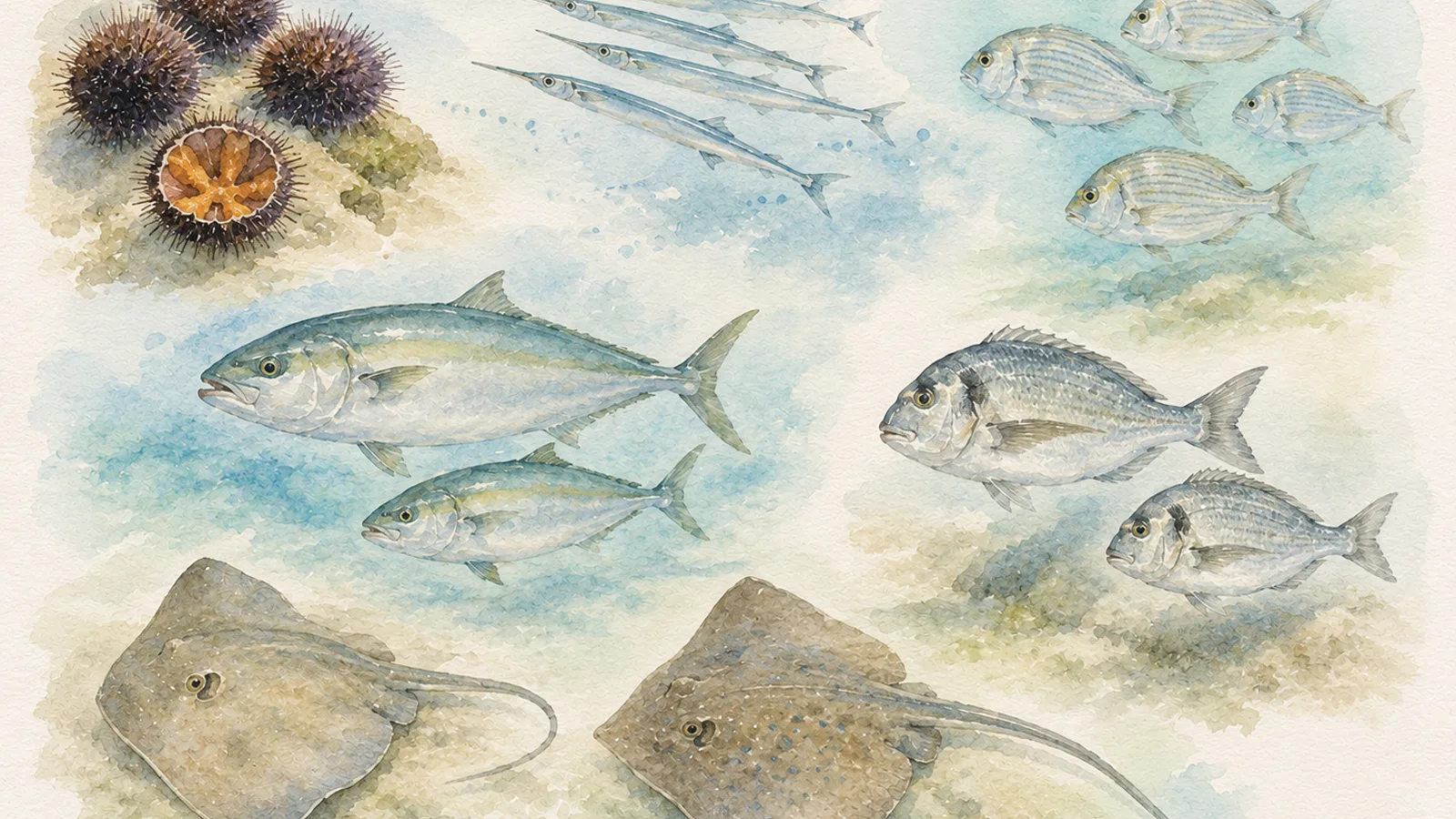
This is where the most varied life gathers, and the reason the best snorkeling on Elba is along the rocky edges of the beaches. Among the rocks move bream, striped, curious and easy to approach; saddled bream, silvery, in shoals at mid-water; wrasse of several kinds, the most colourful fish of the Mediterranean, green, orange and blue; mullet gliding just below the surface. In the crevices hide octopus (look for the den, often given away by a little heap of shells at the entrance) and moray eels, which show only their heads: never put your hands into the holes. On the boulders you find starfish, sea urchins (watch your feet) and crabs, while deeper down, on the shaded walls, the gorgonians begin, the red and yellow fans that are the divers' spectacle.
The sandy bottom and the open water
On the pale sand you see red mullet rooting with their snouts, the odd camouflaged sole or turbot, and the tracks of octopus. Offshore, and more often from a boat than from the shore, pass predators such as sea bass, amberjack and bonito, and big fish like groupers, which however stay in the deep crevices. Beyond the reach of snorkeling, but for completeness: in Elba's waters, within the Pelagos Sanctuary, swim dolphins too (striped and bottlenose), which you happen to cross on boat trips.
Look, do not touch
The golden rule is simple: you observe, you do not touch and you do not collect. No fins banging on the bottom, no hands in the dens, no shells or urchins as "souvenirs". If Elba's water is still this alive, it is precisely because, for the most part, it is left in peace.
Gear: what you really need
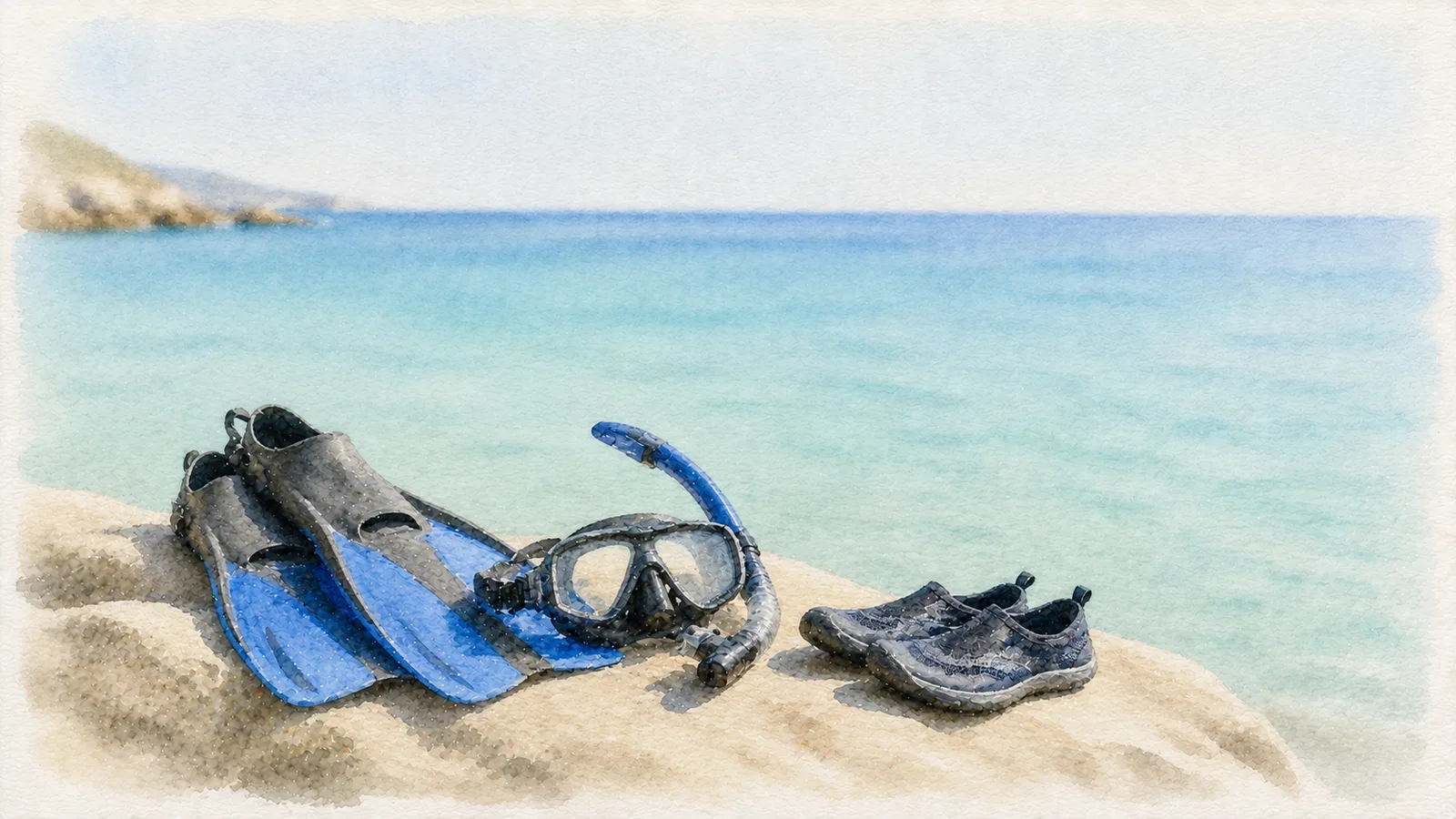
The bare minimum is mask, snorkel and fins. But on this coast rock shoes are not optional: the rocky bottoms do not forgive bare feet when you enter the water. A light wetsuit is useful in May, June and October, when the water is still cool or already cooling. And if you plan to swim out, towards the wreck or near boat routes, a diver's buoy makes you visible and costs little.
When to go and the right conditions
The best period runs from June to September. September is the snorkeling month on Elba: the water is still warm after summer, visibility is often at its best and boat traffic drops sharply compared with August. June is excellent too: clear water already, few boats, no crowds. July and August work, but watch the boat traffic in the busier areas, above all at the Pomonte wreck. If you want the full seasonal picture, it is in our guide on when to go to Elba Island.
The best conditions are in the morning: calm water, light that penetrates well, fewer boats. In the afternoon the Mediterranean can pick up even without strong wind, and then visibility drops. If you see wind or a rough sea, putting it off is always the right call: with murky water you see nothing and the swim is just tiring.
Snorkeling with children and beginners
For those starting out, or for a day with children, go for the shallow, sheltered bottoms: the central part of Seccheto, the sand of Cavoli and Fetovaia, or Lacona beach on the south side, wide and gently shelving. These are places where you can stand with your feet on the bottom and get used to mask and snorkel without anxiety. The Pomonte wreck, instead, requires swimming in deep water: save it for when the little ones are confident swimmers.
Common sense and respect for the sea
Never snorkel alone: it is a simple rule that always holds, not just for beginners. Do not touch and do not collect anything: urchins, octopus, starfish and posidonia are part of an ecosystem that fares better without hands on it. Near boat routes, a diver's buoy makes you visible. And where there are marine protected areas, like the Scoglietto, respect the bans: it is also the reason there are so many fish there.
Frequently asked questions
Where can you snorkel on Elba Island?
Almost anywhere from the shore. The best-loved spots are the Elviscot wreck at Pomonte, the south-west coast between Seccheto, Cavoli and Fetovaia, the Scoglietto off Portoferraio (by boat, the richest in fish) and the Capoliveri coves such as Innamorata and Norsi.
What is the most beautiful snorkeling spot on Elba?
The most memorable is the Elviscot wreck at Pomonte: a cargo ship that sank in 1972, resting at 12 metres, 150 metres from the beach, with almost no currents. For sheer abundance of fish, instead, the Scoglietto off Portoferraio, inside a marine protected area.
Can you see the Pomonte wreck snorkeling from the shore?
Yes. You set off from Pomonte beach and swim out to the Ogliera rock; the wreck is just 12 metres deep and, in clear water, easy to see from the surface. You do need to be able to swim in deep water, though: it is not suitable for small children.
When is the best time for snorkeling on Elba?
From June to September, with September often the best month: warm water still, top visibility and fewer boats. The morning, with a calm sea, always gives the best conditions.
Do you need a wetsuit?
It is not compulsory in high summer. A light wetsuit helps in May, June and October, when the water is cooler. Rock shoes, on the other hand, are essential on the rocky coasts.
Where can you snorkel with children on Elba?
On the shallow, sheltered bottoms: the centre of Seccheto, the sand of Cavoli and Fetovaia, or Lacona beach. With little ones, better to avoid the deep-water spots like the Pomonte wreck.
What do you see snorkeling on Elba?
Over the posidonia meadows swim shoals of damselfish, salema and pipefish; among the rocks bream, saddled bream, colourful wrasse, octopus and moray eels; on the sandy bottom red mullet. Dolphins, instead, are spotted from a boat, in the Pelagos Sanctuary.
Can you swim with dolphins on Elba?
No. Elba's dolphins are wild and live in the Pelagos Sanctuary, where disturbing them is not allowed: you watch them from a boat, keeping your distance, above all on the north-west side. Many trips combine the sighting with snorkeling stops in the coves.
Where to stay to have it all within fin's reach
The Casa Azzurrina apartments are in Seccheto, a few steps from the beach. You can set off in the morning with your mask, come back for lunch, and in the afternoon move on towards Pomonte for the wreck. Not everywhere lets you plan a day like this, with snorkeling that starts right below the house. Here you can.