Casa Azzurrina
There's a particular kind of excitement that runs through a small island when sea turtles nest on one of its beaches. It's not the same as a whale sighting or a rare bird — it's quieter than that, more patient, drawn out over weeks. A nest is discovered. Volunteers appear with stakes and tape. People start checking on it the way they'd check on a neighbor who's expecting.
Lacona beach, on Elba's south coast, has been that kind of place in recent summers.
The species
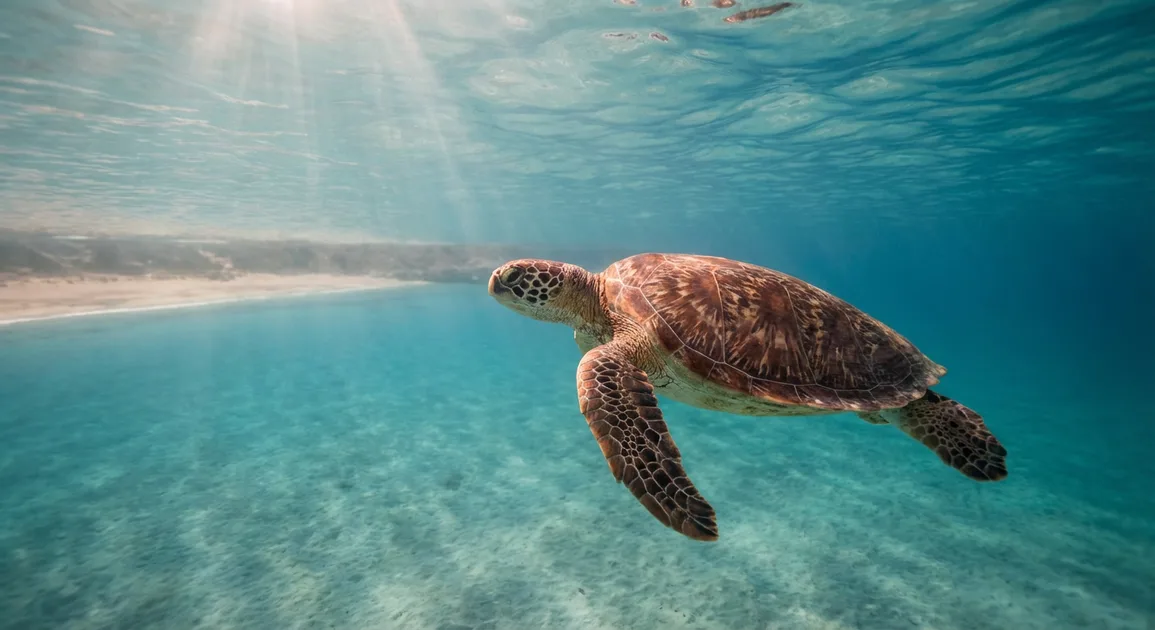
The turtle in question is Caretta caretta — the loggerhead sea turtle. The name comes from its disproportionately large head, which houses the powerful jaws it uses to crush the crustaceans and shellfish it feeds on. Adults typically reach 90 centimetres in length and can weigh more than 100 kilograms. They're not fast on land. They're not trying to be.
The Mediterranean population of loggerheads is genetically distinct from the Atlantic population — they've been separated long enough that they've diverged, and they have their own established nesting grounds around the basin. The main nesting beaches have historically been in Greece (Zakynthos is the most famous), Turkey, and Libya. But the range of nesting activity has been expanding northward and westward for decades, partly because of conservation effort, partly because of shifting sea temperatures.
On the IUCN Red List, loggerheads are listed as vulnerable globally. The Mediterranean subpopulation has its own dynamics: Greek and Turkish beaches have seen some recovery as protections improved, but pressure from tourism development, fishing bycatch, and marine pollution remains significant throughout the basin.
Lacona
The beach at Lacona is about 20 minutes by car from Seccheto, east along the southern coast and then north into a wide bay that opens toward the island's interior. It's one of Elba's longer sandy stretches — broad, with a gradual slope into the water, the kind of profile that loggerheads prefer for nesting. The bay is partially protected from the prevailing winds, which keeps it calmer than many of the more exposed southern beaches.
In recent summers, it has become one of the island's active nesting sites. That's not a phrase that means much in the abstract, so it's worth understanding what it actually involves.
How a nest happens
A female loggerhead that returns to nest is typically doing so on or near the beach where she herself hatched — potentially decades earlier. The homing instinct is precise in ways that still aren't fully understood. She comes ashore at night, moving slowly up the beach above the high-tide line, and digs a flask-shaped cavity in the sand using her rear flippers. She lays somewhere between 60 and 120 eggs, covers the nest, and returns to the sea. The whole process takes one to two hours. She will not come back to the nest.
The nest is then on its own — except that when one is discovered on a monitored beach, it isn't entirely. Volunteers from local conservation groups, often coordinating with organizations like WWF Italia or the national park authority, mark and fence the nest perimeter. They monitor it daily, track sand temperature (which influences the incubation rate, and even the sex ratio of the hatchlings), and wait.
The waiting period is 45 to 70 days, depending on conditions. When the eggs hatch, the hatchlings — already coordinated in their movement despite having never met another turtle — work together to dig upward through the sand, often emerging over the course of several nights. They head for the sea guided by the brightness of the horizon over the water, which is why artificial lighting on or near nesting beaches is genuinely disruptive rather than just theoretically problematic. A hatchling moving toward a beach bar's terrace lights instead of the sea is not going to make it.
In 2023, around 89 hatchlings emerged from nests on Lacona — a number that circulated widely in Italian conservation and environmental media. For a Mediterranean island that had not historically been a nesting site, it was a significant event.
What this requires of visitors
You cannot approach or disturb a known nest. This isn't a soft suggestion — nesting sites are protected under Italian law, and disturbance can be a criminal offence. If you see a staked perimeter on the beach, stay outside it and move on. Volunteers monitoring the nest are usually present and are generally happy to explain the situation to curious visitors; they are not there to perform it for onlookers, and it's worth keeping that distinction clear.
What you can do is more diffuse but genuinely useful. Keep Lacona clean — plastic debris on the beach is a direct hazard for loggerheads and for hatchlings. If you're on or near the beach after dark during summer months, minimize artificial light: dim your phone screen, don't use torches pointed at the waterline, ask others to do the same. These things matter in aggregate.
Some summers, organized hatchling-watch events are possible — ask locally when you arrive, or check with the park information office in Portoferraio. But go without expectations. Wildlife doesn't perform on schedule, and the unpredictability is part of what makes it real rather than curated.
Why we pay attention to this
The Tuscan Archipelago — which includes Elba — is a national park. That designation exists because the marine and terrestrial ecosystems here are genuinely valuable and genuinely under pressure. The return of loggerhead turtles to Elba's beaches is not an accident. It's the accumulated result of decades of effort: trawling regulations, beach management practices, volunteer monitoring programs, and a gradual shift in how the fishing industry relates to bycatch.
It's also not secure. The conditions that make Lacona suitable for nesting can be altered quickly — by development pressure on the beach, by unmanaged tourism, by warming water temperatures affecting prey availability. The turtles are an indicator. When they're nesting successfully, it means the broader system is functioning at a level that supports them.
We care about this because the health of the marine environment around Elba is not separate from the experience we offer guests at Casa Azzurrina. A sea that hosts nesting loggerheads is a sea worth protecting. That's not a marketing position — it's just the logic of why any of us are here.
If you're visiting in late August or September, Lacona is worth a trip specifically to check whether there's an active nest. The volunteers, if present, will tell you more in twenty minutes than we can in twenty paragraphs. But arrive with patience, not expectation.