Casa Azzurrina
An island that makes wine on its own terms
There's a category of wine that exists primarily for the people fortunate enough to be in the right place. It doesn't need critical endorsement or export markets. It grows in a particular soil, under a particular light, and it makes the most sense in the context where it was made. Elba's wines belong to this category.
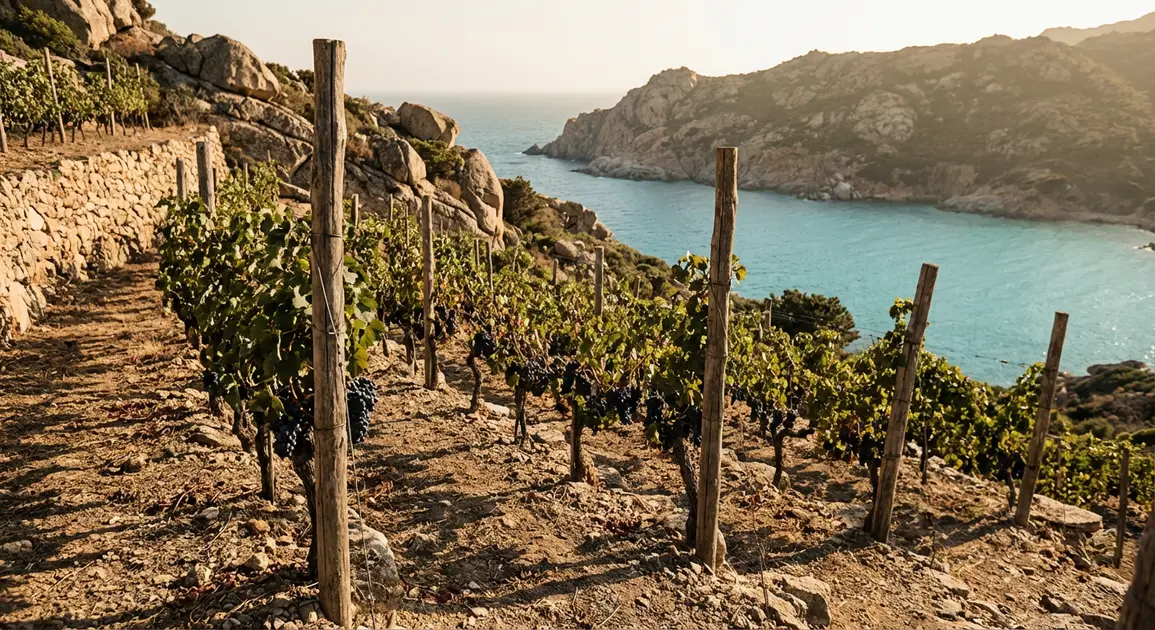
The Elba DOC designation has existed since 1967, which makes it one of the older appellations in Tuscany. The island's terrain — a mix of ancient granite, metamorphic rocks, and iron-rich soils left over from centuries of mining activity — produces conditions that are genuinely distinctive. Add constant sea breezes, warm summers with cool nights, and the kind of careful small-scale viticulture that large commercial operations can't replicate, and you have the foundations for wines that are worth understanding.
Most of Elba's production is consumed on the island itself. This is not because the wines aren't good enough for the mainland; it's because the volumes are small, the producers are often small family operations, and there's no shortage of local demand from the island's nearly three million tourist overnight stays a year. For anyone staying here, that scarcity is an advantage: the best bottles are available from producers and local restaurants, not from wine shops in Milan or London.
Ansonica: the wine of the island's summer
Ansonica is Elba's principal white grape, and it's the wine you'll drink most of while you're here. The same grape goes by the name Inzolia in Sicily, where it's used in both dry whites and as a component of Marsala, but on Elba it expresses itself differently. The sea air, the granite soils of the southwest coast in particular, and the island's harvest timing produce a white with a distinctive aromatic quality: Mediterranean herbs, white peach, a faint salinity that isn't actually salt but reads as such because of the maritime influence on the vines.
At its best, Ansonica is dry, full-bodied for a white, and has enough structure to pair with the local food without being overwhelmed by it. The best food pairing on Elba is the obvious one: fresh seafood. Totani alla piastra — flying squid, grilled with olive oil and a little lemon — is the dish. A young, fresh Ansonica, served cold, is the wine. The combination works in the way that regional pairings tend to work when they've had centuries to develop: effortlessly, and not quite replicable anywhere else.
Ansonica is best drunk young. The aromatic quality fades with age; the wines to seek out are the most recent vintages from the producer's cellar. If a bottle has been sitting on a restaurant wine list for four years, ask for something else.
Aleatico dell'Elba: the wine worth going home with
If Ansonica is what you drink at lunch on Elba, Aleatico is what you take home.
Aleatico is a red grape with ancient roots on the island — exactly how ancient is a matter of some debate among ampelographers, but the consensus is that it arrived in the Mediterranean basin from Greece many centuries ago. On Elba, it's made into a passito-style wine: the grapes are partially dried on the vine or on racks after harvest, concentrating their sugars and intensifying their aromatics, before fermentation produces a sweet red of considerable depth.
The result is unlike most Italian sweet wines. The colour is deep ruby, almost garnet. The nose is striking: rose petals, morello cherry, and a dark spice that comes from the skin contact during the drying process. On the palate it's sweet but not cloying — there's an acidity underneath that keeps it alive, and a warmth from the alcohol that is the point. Drink it slightly chilled, around 14–16 degrees, which tames the sweetness and brings out the floral quality.
The Aleatico Passito dell'Elba DOCG (the higher designation, granted in 2011) represents the island's most serious production of this wine: stricter rules on grape selection, yield limits, and the proportion of dried fruit. Production is genuinely small — a few tens of thousands of bottles per year across all producers — and availability outside the island is limited. If you see a bottle, buy it. It travels well and it keeps for five to ten years in a cool cellar.
Napoleon, during his exile on Elba from 1814 to 1815, reportedly developed a particular fondness for the local Aleatico. Whether this is historically documented or islander mythology embellished over two centuries is hard to say with certainty, but it makes a good story, and anyone who has had a good bottle of Aleatico Passito dell'Elba DOCG on a warm evening would find it entirely plausible.
The harvest
Aleatico is typically harvested earlier than most red grapes — at the end of summer, ahead of the main Sangiovese harvest. The berries are small and prone to splitting, which requires careful hand-picking. In September and October, during harvest, you'll encounter tractors on the narrow roads of the island's interior and the smell of fermenting must from open cellar doors. This is one of the better times to visit Elba if you can manage it — the weather is still warm, the beaches are quieter, and the island is doing something other than servicing tourism.
Elba Rosso: the everyday wine
A note on the island's red table wine. Elba Rosso is a blend of Sangiovese — the backbone of Chianti and Brunello on the mainland — with local varieties including Canaiolo and Syrah in some interpretations. It's an honest, approachable wine that goes with almost everything. It doesn't make grand claims. It pairs with grilled lamb, with aged pecorino from the nearby Maremma, with a plate of pasta all'arrabbiata. Order it by the carafe at a village trattoria and it will not disappoint.
It's not the wine to take home and cellar for five years. But it's the wine to drink at lunch when you've been swimming since nine in the morning and the sun is high and you want something that doesn't require a decision. There's a category for that kind of wine and it's an important one.
Where to taste and where to buy
Azienda Agricola Arrighi (Porto Azzurro)
One of Elba's best-known producers, with a long family history on the island. Arrighi produces a clean, well-made Ansonica and what many consider a benchmark Aleatico dell'Elba. The cantina is open for visits and tastings in Porto Azzurro on the eastern coast — it's worth the drive across the island. They also sell directly, which is the best way to secure bottles of the Aleatico Passito DOCG when available.
Tenuta La Chiusa (Magazzini, near Portoferraio)
An historic estate with a beautiful position looking out over the Portoferraio bay. La Chiusa's Ansonica is one of the most refined expressions of the grape on the island — there's a mineral quality here that probably comes from the iron-rich soils of the northern coast. The setting is worth the visit alone. Open for tastings; check ahead in summer as hours vary.
Cantina dell'Elba
A cooperative drawing from multiple island growers, which makes it an excellent starting point for anyone who wants a broad overview of what Elba produces. The range is wide, the prices are reasonable, and the staff are generally knowledgeable about what they're selling. Available in many local shops and restaurants; the cantina itself is a good destination for stocking up before the drive home.
The best source you won't find in a guide
Ask the owner of whatever restaurant you're in what they would drink. Not what's on the list — what they would actually open for themselves. On a small island where many restaurant owners have direct relationships with the local producers, this question often yields a bottle that never appears in a wine guide. Small productions, family labels, wines made in quantities too small for commercial distribution.
This is how we've found some of the best bottles we've had on Elba. A question asked unpretentiously, in a restaurant that's been here longer than most of its customers.
A practical note on visiting producers
Most of Elba's wine producers are small operations — a family, a few hectares of vines, a cellar that doubles as a tasting room. Outside of August, most are happy to receive visitors and sell directly without an appointment. In August, call ahead. Some close entirely for a few weeks during high summer because the family is simply too busy with harvest preparation or, ironically, because they've sold out.
The reward for going directly is the conversation. These are people who have been farming the same land for multiple generations. They know things about the island's soils, microclimates, and agricultural history that don't appear in any guidebook. A visit to a serious producer here is rarely just about the wine; it's an education in the place itself.
What to take home
If you can only take one bottle: Aleatico Passito dell'Elba DOCG, from Arrighi or a similarly serious producer. Buy it when you see it — don't assume you'll find it again before you leave.
If you want to take the island home in a more complete way: a bottle of Ansonica, ideally from the most recent harvest, and a bottle of Aleatico. Open the Ansonica the first week back. Save the Aleatico for a winter evening when the idea of an island in the Tyrrhenian Sea feels like something you imagined.
It will taste like you remembered. That's the point.