Casa Azzurrina
We've been asked this question more times than we can count. Friends planning summer holidays, guests at Casa Azzurrina before they first visit, people who've loved one of the three islands and are wondering if another might suit them better. The honest answer is that Elba, Sardinia, and Corsica are not interchangeable Mediterranean destinations — they have distinct personalities, different price points, different crowd dynamics, and different strengths. Choosing the wrong one for your particular travel style is a real risk.
So here's our honest take, having spent significant time on all three.
Getting There: Accessibility Matters More Than You Think
This is often overlooked in travel writing but it shapes the entire experience — who shows up, how tired they arrive, what the first and last hours feel like.
Elba
Elba is reached by ferry from Piombino, on the Tuscan coast. The crossing takes roughly one hour. You can be on the island within a day's drive from most of northern Italy, a comfortable day trip from Florence, or a straightforward connection from Pisa airport. The ferry runs frequently — multiple crossings a day, year-round. In peak season you'll want to book a car ferry in advance, but the mechanics of getting there are simple and relatively forgiving. No overnight ferry. No flight delays. No airport transfer on the other side.
Sardinia
Sardinia is a proper journey. By ferry from Genoa, Livorno, or Civitavecchia, you're looking at anywhere from six to twelve hours depending on the route and operator. These are overnight crossings or full-day sailings. By plane from most Italian or European cities, you can get there in under two hours, but then you're dependent on airline schedules and paying for the flight. Neither option is difficult, but neither is casual. Getting to Sardinia requires commitment — which is fine if you're planning a ten-day or two-week trip, less ideal for a shorter stay.
Corsica
Corsica sits between the two. Ferries run from Piombino (in summer), Livorno, Genoa, Nice, and Marseille, with crossings ranging from about three and a half hours from Piombino to a full night from Marseille. It's quicker than Sardinia by sea but slower than Elba. There are also flights into Ajaccio, Bastia, and Calvi from various European cities. The island straddles a French-Italian border in logistical terms — you can reach it from both countries, which gives it a wider catchment but also means the infrastructure has a distinctly different feel from the Italian mainland.
The practical upshot: Elba wins on accessibility, especially for travelers coming from central and northern Italy. Sardinia and Corsica require more planning and usually a longer minimum stay to justify the journey.
Crowds: The Honest Picture
Sardinia
Sardinia's Costa Smeralda, in the northeast, is one of the most intensely crowded luxury destinations in the Mediterranean during July and August. Porto Cervo and Cala di Volpe are genuinely beautiful — and genuinely heaving. Beaches are managed with sunbed concessions, restaurants require reservations well in advance, and the general atmosphere in peak season is more Côte d'Azur than quiet Italian island. If that's the experience you want, fine — it delivers. But if you're expecting tranquillity, the Costa Smeralda in August will disappoint you.
Sardinia's southern and western coasts are considerably quieter, but getting to them requires knowing the island or good planning.
Corsica
Corsica is busy in summer, particularly in the north around Calvi and the Balagne region, and along the western coast. The island has managed its tourism more consciously than Sardinia — camping is regulated, certain areas are protected — but busy remains busy. The interior and far south are much quieter, but reaching them often requires committed driving on mountain roads.
Elba
Elba sees its peak in August, when Italian families arrive en masse. The northern coast, Portoferraio, and Marina di Campo can feel crowded during that month. But the southwest corner of the island — our corner, around Seccheto and Cavoli — is structurally quieter. The roads narrow, the beach bars are smaller, the parking is manageable. This isn't accidental: it's geography and limited infrastructure working in your favor. Even in August, you can find a rhythm here that doesn't feel frantic.
In September, Elba transforms. The difference between August and September on this island is one of the more dramatic travel mood shifts we've experienced in Italy.
Beaches: What You're Actually Getting
Sardinia
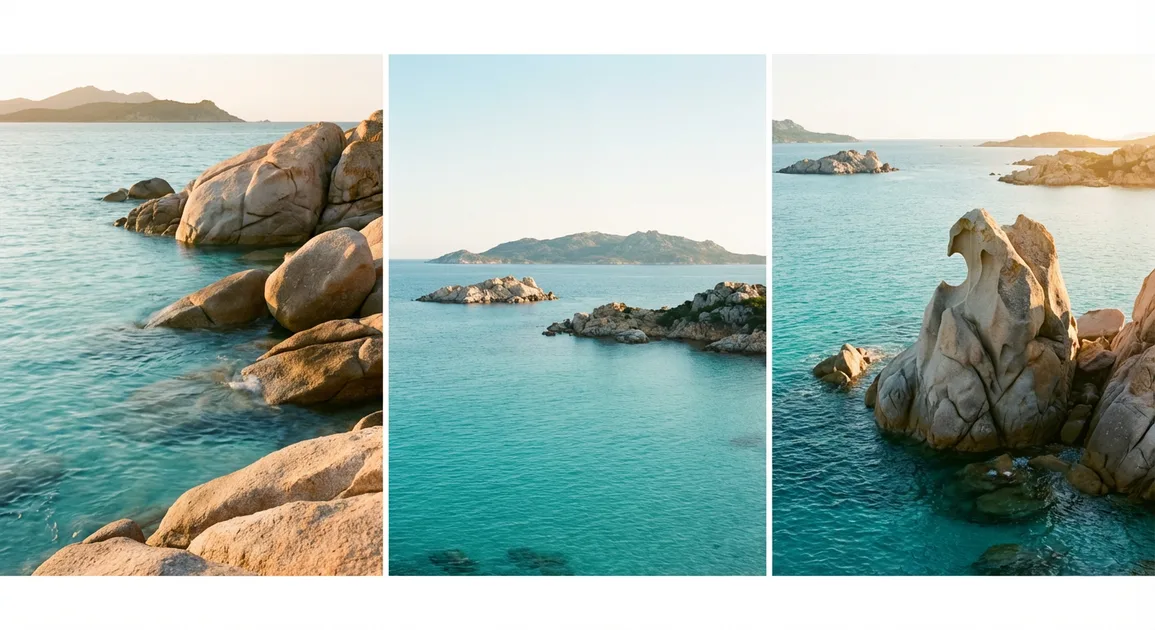
Sardinia's beaches are legitimately world-class. The fine white sand on the Costa Smeralda, the Maddalena Archipelago, and parts of the south (Villasimius, Chia) is some of the most beautiful in Europe. The water color — that specific turquoise — is hard to argue with. If beaches are the primary reason you're going, and you want the kind of beach that photographs extraordinarily well, Sardinia delivers.
The trade-off: many of the best beaches are managed, access can be controlled, and sunbed culture is dominant at the popular spots.
Corsica
Corsica's beaches are more varied in character. You have the dramatic gulf beaches like those around Porto and Girolata — backed by mountains, with intense color contrasts. The northern beaches around Calvi, and those at Palombaggia and around Bonifacio in the south, are genuinely beautiful. Corsica's coastline is wilder in feel than Sardinia's, less manicured. Some beaches are accessible only by boat or via trails, which keeps them cleaner and less crowded.
Elba
Elba has over one hundred beaches, and the variety is real. Sandy beaches in the southwest (Seccheto, Cavoli, Fetovaia), dramatic rocky coves along the north coast, pebble and mixed beaches on the east. The water is clear — not Sardinian-turquoise, but genuinely clean and swimmable. What Elba offers that neither Sardinia nor Corsica quite matches is compactness: you can reach completely different beach experiences within thirty minutes of each other. If a beach doesn't suit you today, a different one will tomorrow, and neither is more than a short drive away.
Landscape: What the Interior Looks Like
Sardinia
Sardinia is large — almost three times the size of Corsica, far larger than Elba. The coastal landscape is dramatic in parts, particularly in the east (the Ogliastra), but much of the interior is flatter scrubland and agricultural land. The landscape is ancient-feeling in a way that's hard to describe — the Nuragic towers that dot the countryside contribute to this. It doesn't feel like the Italian mainland, which is part of its appeal.
Corsica
Corsica is mountainous in a way that will surprise first-time visitors. Monte Cinto reaches 2,706 metres. Snow can remain on the peaks into June. The interior is dense with maquis scrubland, chestnut forests, and mountain villages that feel genuinely remote. The combination of high mountain and sea within a very short distance is dramatic and beautiful. The GR20 hiking trail, crossing the island north to south, is considered one of the great long-distance walks in Europe.
Elba
Elba is compact — about 27 kilometres from end to end. The landscape is remarkably varied for an island this size: granite outcrops in the west, iron-ore hills around Rio and the east (centuries of mining have left a distinctive reddish landscape), vineyards, pine and holm oak forests, and small agricultural valleys. Monte Capanne, the highest point at 1,019 metres, can be reached by gondola or on foot and gives views across to Corsica, the Tuscan coast, and on clear days further south. It's not a dramatic landscape in the Corsican sense, but it's surprising — you don't expect this much variety from an island this size.
Cultural Identity: What Kind of Italy (or Not)
Elba
Elba is unmistakably Tuscan Italian. The food, the dialect, the village bars, the pace of daily life — all of it connects directly to the mainland Tuscan tradition. Napoleon's brief exile here (ten months in 1814-15) left some interesting historical sites, but it hasn't shaped the culture. The island feels like a quieter, more intimate version of the Tuscany you might know from the mainland.
Corsica
Corsica has a genuinely distinct identity. Technically French since 1768, it maintains a strong Corsican cultural identity — its own language, its own music (polyphonic choral singing), its own food traditions. The island has a complicated political history with France that adds an atmospheric edge. Some restaurants and signs are in Corsican only. It's an interesting place to be, culturally — neither fully French nor Italian, something else.
Sardinia
Sardinia feels the most removed from mainland Italy. The Nuragic civilisation, which built the mysterious stone towers still scattered across the island, predates Roman settlement and is entirely its own thing. Sardinian food, language (which has elements of Spanish, Arabic, and older Italic roots), and social customs feel distinct. Spending time in interior Sardinia is genuinely like visiting a different culture within Italy's borders.
Food and Wine: The Table
Elba
The food on Elba follows Tuscan logic — simple, ingredient-led, unfussy. Fresh fish is excellent, particularly at the smaller harbour restaurants in Sant'Andrea, Marciana Marina, and Seccheto. The island's two wines of note are Ansonica (a dry, slightly mineral white made from a grape brought from Sicily centuries ago) and Aleatico (a sweet red dessert wine, typically served chilled, that is one of the more distinctive things you can drink on this island). Both are produced in small quantities by local estates and are rarely found beyond Elba. Eating and drinking on Elba feels like an extension of Tuscany — which is a considerable compliment.
Corsica
Corsican food is rich, anchored in mountain traditions: slow-braised meats, charcuterie from indigenous pigs (the figatellu sausage, the lonzu cured loin), brocciu cheese made from sheep or goat whey, chestnut flour in everything from bread to pasta. The wine is interesting — Nielluccio (related to Sangiovese), Vermentino, and Sciaccarello are the main varieties, produced in small-scale appellations. It's serious food and wine country, and one of the underappreciated aspects of visiting.
Sardinia
Sardinian cuisine has real depth. Culurgiones — the stuffed pasta filled with potato, pecorino, and mint — are unlike anything else in Italian cooking. Porceddu, the roasted suckling pig, is a festive staple. Pecorino sardo is produced in dozens of variations. Sea urchin (ricci) served simply on bread or with pasta is a northern Sardinian obsession. The wine tradition is anchored by Cannonau, a Grenache-based red that is one of Italy's most characterful DOCs. Food in Sardinia, particularly if you venture away from the tourist coast, is one of its best arguments.
Price Levels: What to Expect
Sardinia
The Costa Smeralda is genuinely expensive — among the most expensive resort areas in the Mediterranean. A hotel room in Porto Cervo in August is a significant investment. Even outside the north, Sardinia's positioning as a prestige destination has pushed prices up across much of the island. Good accommodation, boat charters, and restaurant bills all run high in peak season.
Corsica
Corsica sits at a mid-to-high price level. It's not as extreme as Sardinia's north coast, but it's not cheap. French pricing logic applies to many services and supermarkets. Good accommodation in peak season requires planning and budget.
Elba
Elba is the most accessible of the three in price terms, particularly for quality accommodation. You can stay somewhere genuinely beautiful — a well-designed villa with a garden and proximity to a good beach — for considerably less than comparable accommodation on Sardinia or Corsica. The restaurants, while not cheap in August, are generally fair. The ferry is inexpensive. The island doesn't rely on exclusivity to justify itself, which keeps it honest.
Who Should Go Where: Our Honest Verdict
This is what most comparative guides avoid saying directly. We'll say it.
Go to Sardinia if: You want the definitive Mediterranean luxury beach resort experience. You're happy paying Costa Smeralda prices. You want world-class white sand beaches and don't mind sharing them. You're interested in ancient Nuragic culture and the island's unique identity. You're planning a long trip (ten days minimum to justify the journey) and want maximum variety.
Go to Corsica if: The combination of serious mountains and sea is what excites you. You want dramatic hiking — the GR20 or shorter versions. You're drawn to a culturally complex island with its own distinct identity. You enjoy rich mountain food and small-production wine. You're flying in from northern Europe and Corsica is genuinely the most accessible of the three.
Go to Elba — specifically the southwest — if: You want an authentically Italian island experience without the logistics of a long ferry crossing or flight. You're a couple looking for quiet, unhurried days — good beach in the morning, a glass of Ansonica in the afternoon, dinner at a place where the owner knows his regulars by name. You're a family that wants manageable distances, a calm sea, and an island your children will actually remember fondly rather than endure. You care about food and wine in a Tuscan sense. You want to spend your budget on the experience rather than the access. You have no interest in being seen or in places where being seen matters.
The southwest of Elba — the quieter, less-trafficked corner where the roads narrow and the beach bars don't have DJ sets — is specifically good for travelers who want what Italy does best without what Italian summer tourism often delivers at its worst. We've built a life around this corner of the island, which tells you where we stand.
None of the three islands is the objectively right answer. But they are genuinely different places, and one of them probably fits your particular version of a good holiday rather better than the others.