Casa Azzurrina
There is a paradox that those who know Elba know well: the island is most beautiful when least visited. In spring the Mediterranean scrubland is in bloom, the trails are walkable without the heat, the sea begins to warm up, and prices are still at off-season levels. This is the Elba that locals prefer — and that most tourists overlook.
This guide goes through March, April and May one by one: what to really expect, what is open, what is worth doing and what is better left for summer.
March — the island wakes up
March is the month of transition. The Elban winter gradually gives way to the first colours of the scrubland, lengthening days, and shops and restaurants reopening one by one.
The weather. Daytime temperatures sit between 14 and 17°C, with nights still cool at around 8–10°C. Rainfall, frequent in February, drops off in the second half of the month. Not beach weather, but perfect for walking.
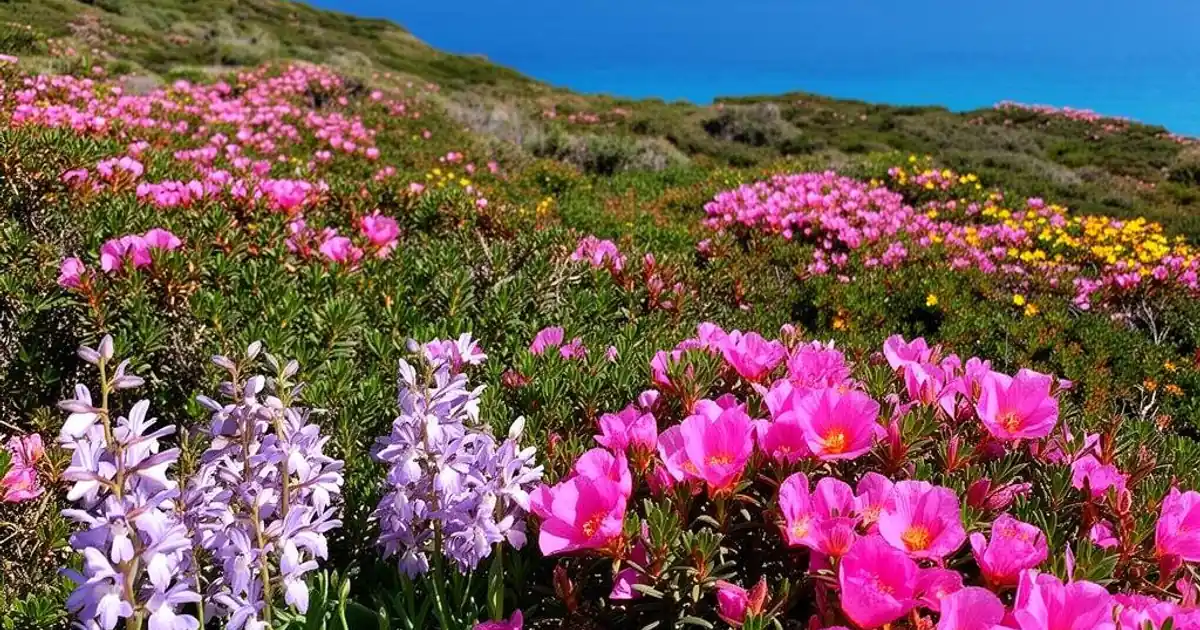
Nature. Pink heather covers the slopes of Monte Capanne from late February; in March white and pink cistus join it, along with wild lavender, and towards the end of the month the first wild orchids appear on sunny meadows. The Tuscan Archipelago National Park is the institutional backdrop, and March is when this richness is most visible.
The trails. Monte Capanne (1,019 m) can be climbed on foot in about three hours. In March you can walk in the middle of the day without any problem — the vegetation is tall and fragrant, and on clear days the view from the summit stretches to Corsica and the Apuan Alps. The cable car is not yet running: the trail is all yours.
What is open. The Napoleonic museums — Villa dei Mulini in Portoferraio and Villa San Martino — open in the first week of March. Most restaurants in the main towns reopen in the third week; in some smaller villages the opening is tied to Easter. Some operators such as Marelibero NoProblem run dolphin- and cetacean-watching excursions year-round.
Prices. Apartments generally cost 30–40% less than at the summer peak. You can book last minute without missing the best options.
April — the best month for those who love to be active
April is the month that, once discovered, is hard to leave behind. Temperatures rise to 17–20°C during the day, the bloom is at its peak, and the island begins to come to life without yet filling up.
Weather and sea. At 16–17°C, the sea is not yet ideal for a long swim. For those who come to walk, cycle or explore, the water temperature is irrelevant.
The bloom. In April the Mediterranean scrubland is at its finest: wild orchids on sunny slopes, yellow broom along coastal paths, cistus in full bloom everywhere. For those interested in botany, Elba in April is a top destination in the western Mediterranean.
Sporting events. April is the month of the Elba Trail, a trail running race starting from Marciana Marina: 26 kilometres with 1,500 metres of positive elevation, from the sea shore up to the summit of Monte Capanne and back through the medieval village of Marciana. Also in April is the Tuscan Archipelago Walking Festival: guided hikes with National Park rangers, marine biologists and naturalists, open to everyone and many of them free.
Easter. In Portoferraio the Good Friday processions are held; in Rio nell'Elba the centuries-old Feast of the Sportella is celebrated at the Hermitage of Santa Caterina. In Campo nell'Elba the Maggio festival takes place, with serenades between young men and women and the traditional corollo pastry. These are traditions that have survived for centuries and are not seen outside the Easter period.
Cycling. The roads are still quiet, temperatures are ideal, and the scenery is at its best. The Capoliveri Bike Park — one of Italy's most renowned MTB bike parks — is operating without the summer crowds.
Logistics. Ferries have good frequencies, car parks in Piombino are available, and booking can be done with just a few days notice.
May — everything open, no queues
May is the month when Elba reaches its best balance: summer infrastructure fully operational, sea that starts to be swimmable, and a crowd level still manageable.
Weather and sea. Temperatures rise to 20–24°C. The sea reaches 19–20°C: from mid-month onwards, swimming is pleasant. Underwater visibility is optimal — conditions for snorkelling are among the best of the year.
What is open. In May everything is running: beach facilities, boat trips, restaurants, hire shops. The finest beaches — Seccheto, Cavoli, Fetovaia, Sant'Andrea — are accessible without competing for parking.
Events. The Rallye Elba opens the season in the first days of the month: special stages from Capoliveri to Marciana Marina–Marciana–Campo, with the finish in Portoferraio. The Elba Island Marathon is run at Marina di Campo. In mid-May the Iron Tour Triathlon Cross takes place. In Marciana Marina the Un Mare di Sapori event is held, dedicated to the island's seafood specialities.
Prices compared to summer. An apartment in May costs on average half as much as in August. The ferry does not require booking weeks in advance. For those with flexible travel arrangements, May is the moment when the quality-price-experience ratio has no equal in the Elban calendar.
What to pack for Elba in spring
Spring on Elba is variable: you can go from a cool morning to an almost summer afternoon in the same day. A lightweight waterproof shell is essential, especially in March. For hiking you need trail shoes — the granite of Monte Capanne does not forgive smooth soles. For snorkelling in May it is worth bringing a light wetsuit (3mm): the water at 19–20°C is swimmable, but for staying underwater for a long time a wetsuit helps. High-factor sunscreen is needed from April onwards.
Getting to Elba in spring — the logistical advantage
In spring, getting to Elba is as straightforward as it will never be at any other time of year. Ferries from Piombino — Moby, Toremar and Blu Navy — run on regular schedules without the summer congestion. Parking in Piombino is available, crossings do not sell out, and ticket prices are noticeably lower than in July and August.
Those who come in spring have a tactical advantage that summer visitors never fully appreciate: the freedom to decide at the last moment. The weather changes? You leave the next day. You want to stay an extra day? There are no booking constraints.