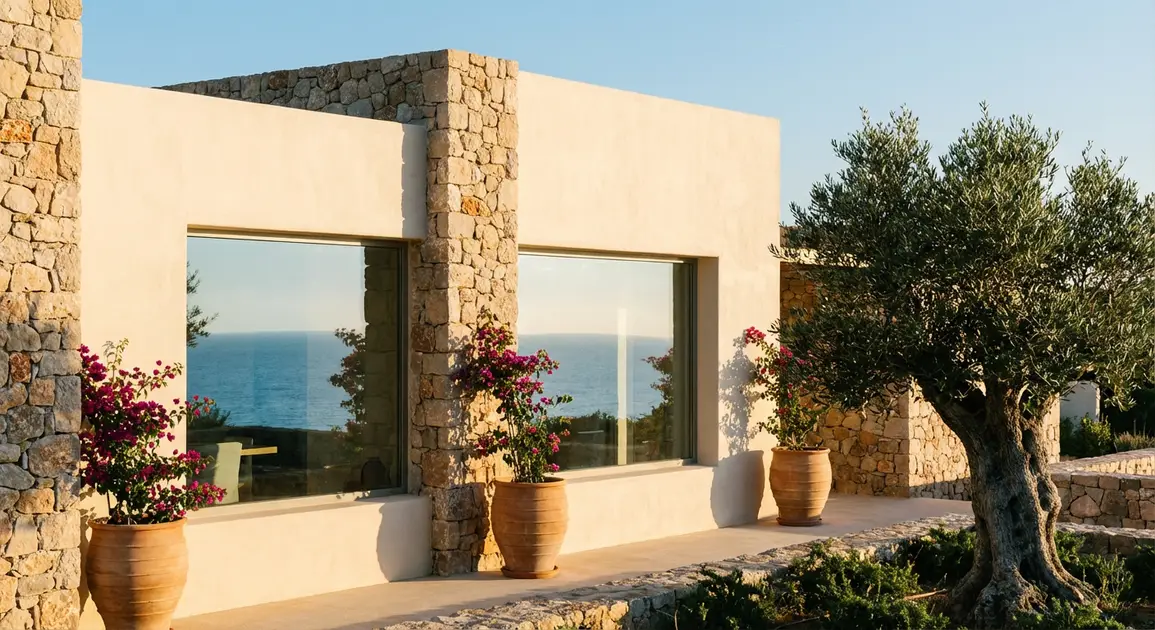
Casa Azzurrina
Building anything on an island forces a kind of clarity that mainland construction rarely demands. There's no convenient grid to plug into, no easy way to truck waste off without cost and logistics. The water supply is finite. The landscape is visible from every room. The guests who come here are coming, specifically, because of what the island is — which means that anything you do to the property that degrades the island works directly against the reason anyone is there.
That's the thinking we started with when we designed Casa Azzurrina. Not a sustainability checklist, not a certification to pursue. Just the question: what does it actually mean to build well in this place?
Materials
Mediterranean architecture has a natural logic to it, developed over centuries precisely because the conditions here are specific. Stone is abundant and local. Terracotta regulates temperature passively. Breathable lime plasters manage humidity without sealing a building airtight. Wood from the island's forests, where available, ages honestly.
We followed those principles because they work — not as an aesthetic gesture, but because materials that belong to a place perform better in that place. The stone we used in some of the walls will look better in twenty years than it does today. The compacted stone floors absorb heat during the day and release it slowly at night. These are not innovations; they're the accumulated knowledge of people who built in this climate for generations, and it seemed foolish to ignore it.
The alternative — imported materials, synthetic surfaces, things designed for a different climate — tends to show its age badly in the Elban context. The salt air and the heat are exacting. You want materials that have already made their peace with both.
Energy
Over the course of a year, the solar panels on the roof produce all the energy the house uses. The house is fully electric, with induction hobs and a heat pump, and has no gas supply at all: the grid is only needed when there's no sun. This is, on Elba, an obvious choice — the island has more sun than most of northern Europe sees in a year, and not using it is simply a waste.
The more interesting design work is in what happens before the solar panels need to do anything. The house is oriented to catch the prevailing sea breezes from the southwest — the same winds that make Seccheto feel ten degrees cooler than Portoferraio on a July afternoon. Deep overhangs shade the south-facing windows during the hottest part of summer days. The floor plan is open enough that cross-ventilation works throughout the house without mechanical assistance.
The result is that on most summer days, the house stays comfortable without any active cooling until the mid-afternoon heat peak, and cools quickly once the evening breeze arrives. That's not an accident of siting — it was designed in from the beginning, and it's the part of the energy strategy we're most satisfied with.
Water
Elba draws on its own water table, but the island's aquifer is under real pressure during summer — the population and the number of visitors both spike sharply, and rainfall is scarce from June through September. This is not an abstract environmental concern; it's a practical one that affects everyone on the island.
Casa Azzurrina has low-flow fixtures throughout. The garden is planted with species that are native or naturalized to the Mediterranean — rosemary, lavender, cistus, agave, native grasses — plants that have evolved specifically to handle the dry summers here without irrigation. During the height of summer we water very rarely, and only in the evening when evaporation loss is minimal.
This sounds simple because it is. The mistake on many properties is to plant gardens designed for a wetter climate and then spend the summer fighting the consequences. We chose differently, and the garden rewards it — it looks right here in a way that a lawn or a flower border never would.
Plastics and single-use items
Casa Azzurrina is supplied without single-use plastic toiletries. We provide reusable bags and glass water bottles that guests can use freely during their stay.
The logic here is not complicated. Single-use plastic on an island accumulates in ways that are disproportionate to its convenience. The ferry brings it in and the same ferry has to take the waste out. Every piece that doesn't arrive doesn't need to leave.
We've also tried to apply the same thinking to what's in the kitchen — reusable wraps, glass storage, no cling film. These aren't dramatic gestures. They're just the obvious choices, once you're paying attention.
What we don't do
We don't buy carbon offsets and describe that as sustainable. We don't put a green label on anything unless we can explain specifically why, in practical terms. We don't claim perfection.
When there's no sun, the house still draws electricity from the grid. Guests drive to Lacona or Portoferraio. The ferry from Piombino runs on diesel. None of that is solved by the choices we've made with the building.
What those choices do is reduce unnecessary consumption in the areas we can control, use materials that belong here, and avoid the lazy defaults that tend to generate waste. Sustainability on an island like Elba is mostly about restraint — using less, wasting less, choosing things that belong. That's the principle. The details follow from it.
What guests notice
The most consistent observation we hear from guests is about the absence of unnecessary things. Casa Azzurrina is fully equipped — there's nothing missing — but it isn't cluttered. The spaces are clear. The surfaces are mostly empty. This is intentional, and it's the same logic that makes the sustainability choices cohere: the question in both cases is what you actually need, and whether what you're adding serves a real purpose.
On an island where the sea is less than three minutes' walk away and the evening light does more than any decor could, the answer to most of those questions turns out to be: less than you think.